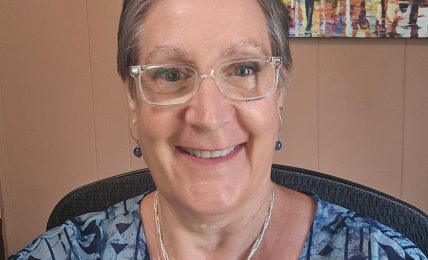
Meet Stacey Holloway: Associate Professor of Sculpture, University of Alabama at Birmingham


We had the good fortune of connecting with Stacey Holloway and we’ve shared our conversation below.
Hi Stacey, why did you decide to pursue a creative path?
I’ve been an artist since I was a child, as I started off drawing and painting at a very young age. This was further encouraged by my mother, who had illustrated the same talent in high school, but never pursued it. As I grew older, my interest in photography and realistic painting landed me in art school where I found a true love of labor through sculpture and installation-based work. I had a required three-dimensional design course and I had made a wooden box for one of the assignments, but my screws were too long and stuck out the other side. My teacher handed me an angle grinder and showed me how to grind them down. From the moment I saw the hot sparks fly, my life changed and I became immersed in sculpture and all its infinite possibilities. 


Can you open up a bit about your work and career? We’re big fans and we’d love for our community to learn more about your work.
My research lies in the advancement, fabrication and exposure of artwork that communicates a universal societal connectivity. The success of this research is reliant on my commitment to my studio practice and research methodologies. Throughout my professional career, I have created multiple bodies of work that utilize a variety of media including drawing, sculpture, ceramics and interactivity. Similar to Surrealist artists, my hyper-exaggerated constructions investigate the subconscious and the balance of instinct and ethics. My research is conducted through a disciplined professional studio practice where technical exploration is married with allegorical architecture. My mixed media installations are created from a series of elements and collections that are appropriated and combined with traditional carving, woodworking, casting, and fabricated structures. I am a visual storyteller. The form of the narrative has been used for centuries to entertain, to preserve culture and to instill morals. Stories can be used to bridge cultures, languages and age barriers. Similar to Aesop, my interests lie in the animal realm and using specific animal attributes to explore how our formative process make up who we might become, or who we are attempting to become. Within the animal kingdom, strong societies are formed within herds, unusual interspecies friendships and adaptation is required, pure instinctual capabilities are necessary for survival, and body language, sounds and scents are used to declare disfavor, profess love, announce dominance, and express pain. Bestial forms, architectural drafting and installations then become the place for metaphors and narratives of uncertainty and longing. “Ethology,” the study of animal behavior with the emphasis on patterns that occur in natural environments, is one model that explores our socio-biological instincts—what drives us to seek similarity and to find our “tribes.” In a recent TedTalk, Frans de Waal, a Dutch/American biologist and ethologist, describes the parallels of moral behavior between primates and humans. De Waal discusses his observations of chimpanzees’ tendency towards reconciliation, leading him to investigate the two essential pillars of morality in the animal kingdom: reciprocity and empathy. These traits can be valued as biological products rather than exclusively deriving from religion, civilization, or tradition. I explore the innate connections between animal and human societies/tribes. Imparting human traits onto animals or expounding human culture through metaphor and allegory breaks apart the perceived divisions between the human and non-human organism. Art can visualize this deconstruction of the human as beast, as well as our conception of “beast” entirely. As a child, my mother and I volunteered at a wildlife rehabilitation center, rode horses together and our home was practically a zoo. My family and I have strong empathetic connections with animals and often become the “voice” for them – especially the injured. I had such unique childhood experiences with animals – from nursing a flying squirrel back to health to helping mom train and raise a disabled cockatiel. I actually wanted to be a veterinarian as a child, but was drawn to art at an early age. It wasn’t until graduate school that I found that I could use my interest in animals to translate my ideas to my viewer. Humans are not so different than other animals; we just have more direct ways of communicating with each other.
If you had a friend visiting you, what are some of the local spots you’d want to take them around to?
I am not native to Atlanta, but have visited multiple times over the years and have found that my favorite places to visit are the High Museum of Art, the Fernbank Museum of Natural History, Zoo Atlanta, and the Georgia Aquarium. I also enjoy seeing all the great artwork and sculptures along the Atlanta BeltLine. And, as a big fan of Jim Henson and Frank Oz, the Center For Puppetry Arts is a must see as well. As a child, I was obsessed with films like The Dark Crystal and Labyrinth and I studied a little bit of puppetry as a minor in grad school.


Who else deserves some credit and recognition?
I have been fortunate enough to have many influences in my life that have supported me throughout my development into an artist. My mother, Shelley Hazzard, has always encouraged me to do what makes me happy and has inspired me to pursue my interests. She was a body builder when I was very young, which allowed me to see what you can do when you stay focused and motivated. I was also very fortunate to have the encouragement and support of my professors throughout the years, who helped me realize my methods and processes – Greg Hull (Interim Dean at Herron School of Art & Design, IUPUI), Eric Nordgulen (Professor at Herron School of Art & Design, IUPUI), and Wayne E. Potratz (Professor Emeritus at University of Minnesota)
Website: https://staceyholloway.com/
Instagram: https://www.instagram.com/hollowspace/
Facebook: https://www.facebook.com/stacey.m.holloway.9
Youtube: https://www.youtube.com/user/staceymholloway/videos
Image Credits
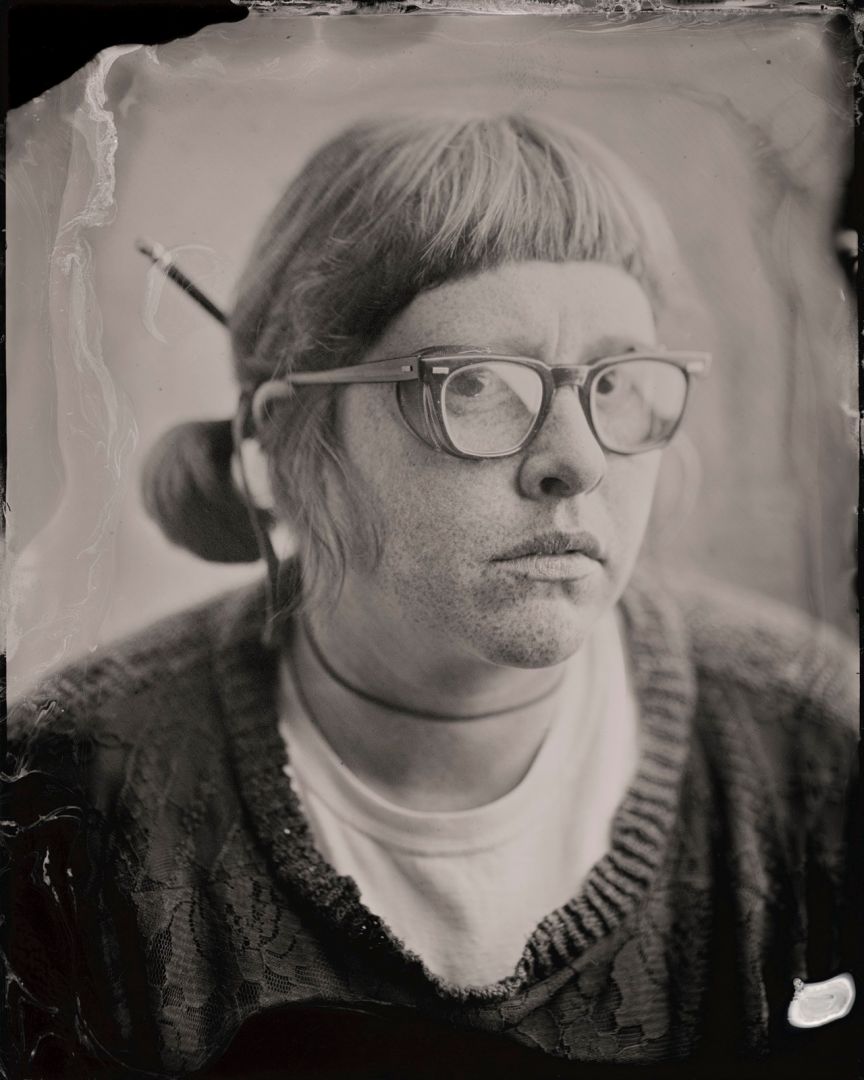
Photo credit for artist head shot: Gusdugger Tintype Photographs, Birmingham, Al. Photo credit for bull in china shop, hands with sheep, sheep on stilts, and deer eating apple house: Jared Ragland Photo credit for walrus with wall otters, iron wolf with plastic doe, nose bridge, sheep with house interior: image provided by artist